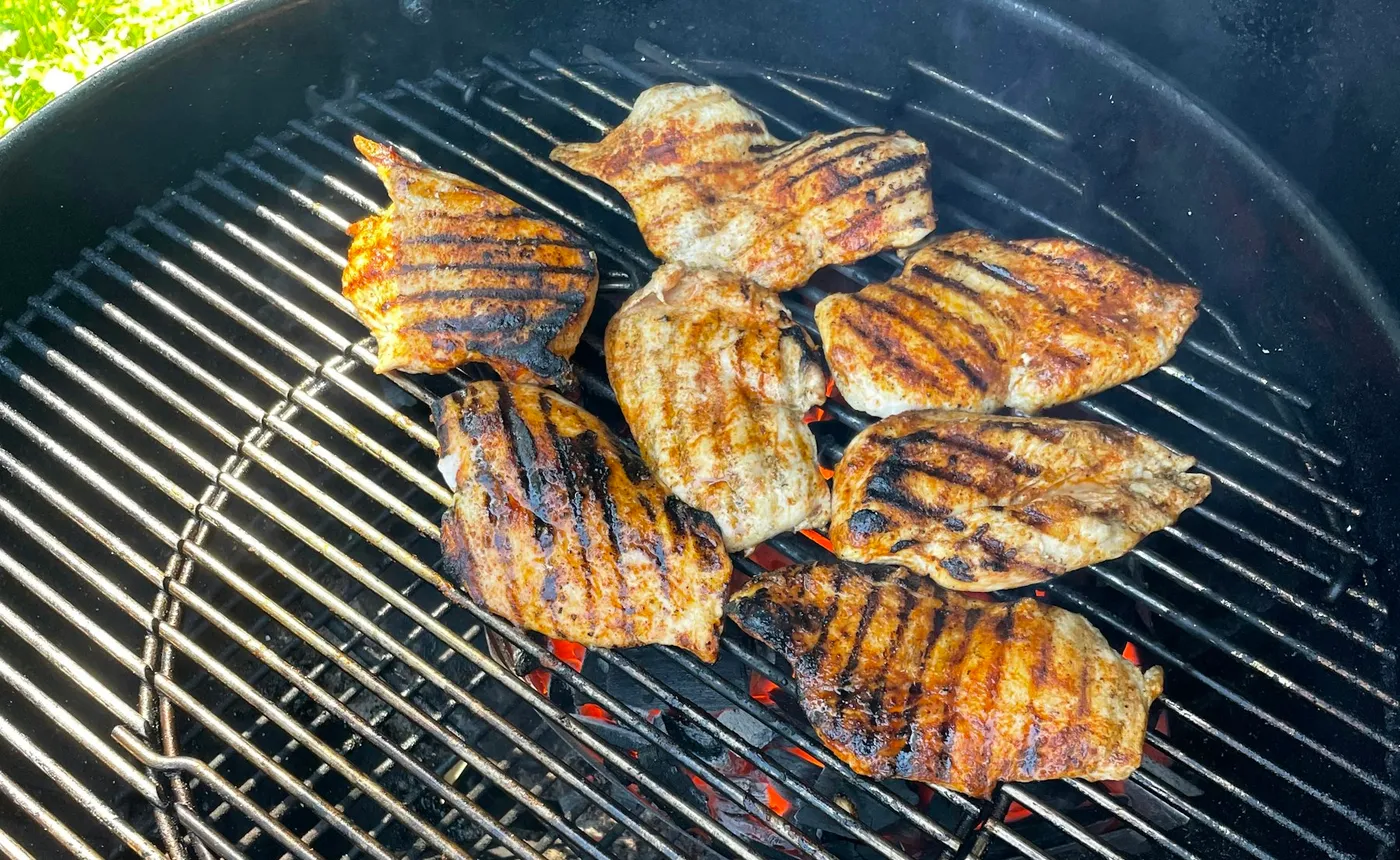
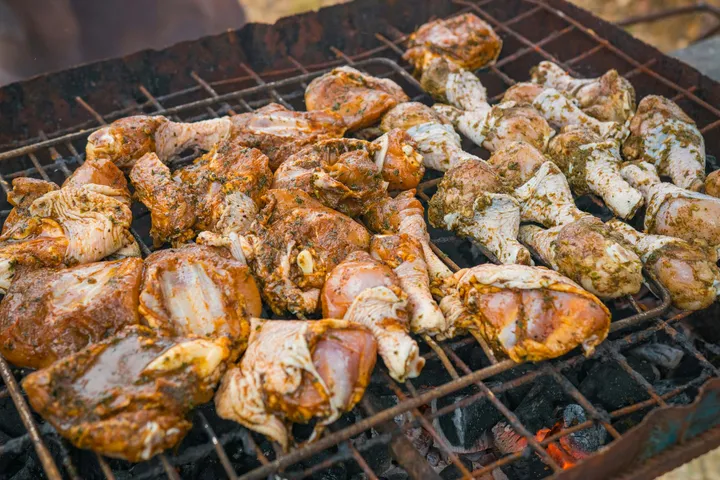
Take a pellet grill chicken breast off at 160°F and it rests up to a juicy 165°F; wait for 165°F on the grill and it finishes dry. After a 45 minute brine, an 8 to 10 oz boneless breast gets to 160°F in about an hour at 250°F on apple pellets.
This recipe is written for four breasts on a Weber Searwood. Of everything in the poultry recipes, boneless breast is the lean cut with no skin and no fat to hide a mistake, which makes it the one most likely to come off tasting like cardboard. If you’d rather cook something forgiving, chicken thighs are the answer. If breast is what’s in the fridge, the brine and the thermometer below are what make it work.
The usual first attempt goes on straight from the package and comes off at 165°F because that’s the number on every chart. After resting it’s at 172°F and chews like a dish towel. Two changes fix it, a short brine and pulling 5°F early, and neither one takes any skill.
Buying breasts that cook evenly
Boneless, skinless breasts of 8 to 10 oz each. Four of them is about 2.5 lb and feeds four. The giant 14 oz breasts in warehouse packs come from very large birds, and they run tougher, with a thick end that takes 20 minutes longer than the thin tail. If that’s what you’ve got, slice each one horizontally into two cutlets and cook them like 6 oz breasts.
Look for breasts without hard white streaks running through the meat. That’s woody breast, a muscle condition in fast-grown birds, and it stays rubbery however you cook it. Air-chilled chicken, if your store has it, holds less water and takes smoke better.
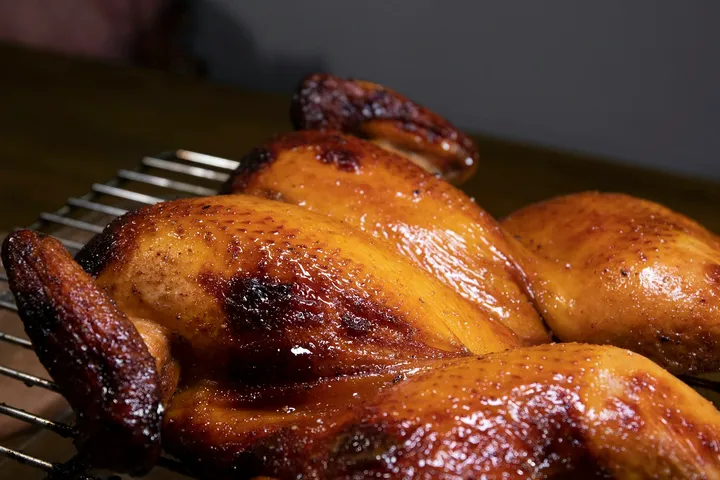
Bone-in, skin-on breasts eat better, but they’re a different cook. Run them at 275°F, then finish at 400°F for the skin the way the thighs page does it, and pull at 160°F.
Chicken breast times at 250°F
| Breast |
Grill temp |
Approximate time |
Pull at |
| Boneless, 6 oz cutlet |
250°F |
35 to 45 min |
160°F, rests to 165°F |
| Boneless, 8 to 10 oz |
250°F |
50 to 70 min |
160°F, rests to 165°F |
| Boneless, 12 to 14 oz |
250°F |
70 to 90 min |
160°F, rests to 165°F |
| Bone-in, skin-on, 12 oz |
275°F, then 400°F |
50 to 60 min |
160°F, rests to 165°F |
| Boneless, 8 to 10 oz |
325°F |
30 to 40 min |
160°F, rests to 165°F |
Times are for breasts that went on cold from the fridge, on a grill holding 250°F at the grate on a day above 50°F. The ranges are wide because breasts vary in thickness more than any other cut. The smoke time calculator gives you an estimate; the thermometer gives you the answer.
Why 250°F and not some other number:
| Grill temp |
What happens to a boneless breast |
| 225°F |
The outside goes leathery during the long wait for the center |
| 250°F |
About an hour of smoke and the meat stays moist |
| 325°F |
Done in 30 to 40 minutes, juicy, light smoke; good for weeknights |
| 350°F |
Done in about half an hour, and it barely tastes smoked |
A 45 minute brine and an even thickness
The brine is a quarter cup of kosher salt and 2 tablespoons of sugar stirred into a quart of cold water. The four breasts go in a bowl or zip bag, fully covered, for 45 minutes to an hour in the fridge. That’s all they need. Breast meat is thin and takes salt quickly, and past an hour the surface turns soft and spongy. If the label says “enhanced” or “contains up to 15 percent solution”, skip the brine entirely; the plant already did it.
Lift the breasts out and pat them dry. Then look at their shape. Most breasts have a thick end and a thin tail, and that difference is the main reason one end dries out while the other is still underdone.
Pit tip: Lay each breast on the board and press the thick end down with the heel of your hand, or give it a few firm whacks with the bottom of a heavy pan, until the whole piece is about an inch thick. Of everything on this page, that step does the most for even cooking.
Rub the breasts with a tablespoon of olive oil and season both sides with the paprika, pepper, garlic powder, onion powder and oregano. There’s no salt in the rub because the brine salted the meat already. If you taste a pinch of the rub on its own it’ll seem flat, which is correct.
No overnight rest needed here. Brined, dried and seasoned, they can go straight on the grill.
An hour at 250°F with one flip
Apple pellets in the hopper. Chicken breast is mild and the cook is short, and apple gives it a light, sweet smoke that doesn’t take over. Hickory works if you like it heavier, but after an hour on hickory a skinless breast tastes mostly of smoke. Cherry is a fair middle ground and colors the surface more.
Set 250°F and let the grill hold for 10 minutes after it reports ready. The breasts go on with space between them, and a leave-in probe goes into the thickest one, pushed in from the end so the tip sits in the center. Most grills run a little hotter at one end, so the thickest breast goes there.
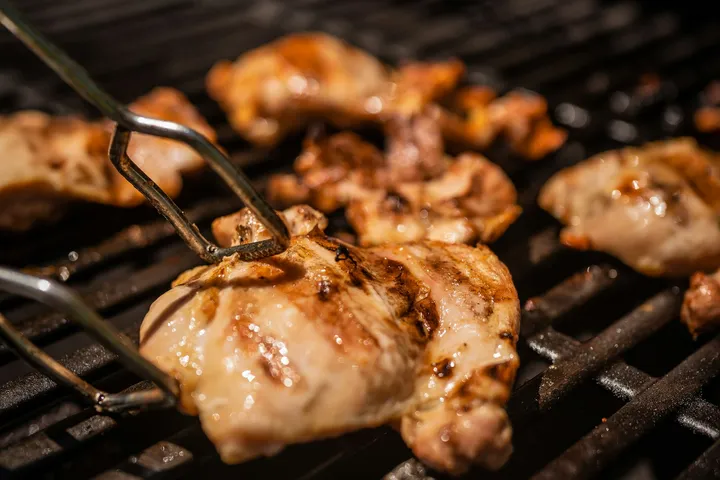
Close the lid for 30 minutes. Then flip each breast and swap the hot-end ones with the cool-end ones. Skinless meat has nothing protecting it, and the side facing the heat deflector dries if it stays down the whole time.
Start checking at 45 minutes. An 8 to 10 oz breast is usually reading 140 to 150°F by then.
Watch out: The last 10°F goes fast, about 2°F a minute. Once the probe passes 150°F, stay at the grill with an instant-read in hand. This is the stretch where a juicy breast turns dry while you’re inside getting plates.
The common early mistake is probing the wrong breast. With the probe in the thinnest of four, it can hit 160°F at 40 minutes while the thickest is still 148°F in the middle. Pull them all on that reading and the thick one goes back on while the rest go cold. Put the probe in the thickest breast and check each of the others separately before it comes off.
Pull each breast at 160°F
Pull each breast at 160°F in the thickest part. Push the instant-read in from the end so the tip sits in the center, rather than straight down from the top, where it’s easy to go all the way through and read the grate. Check every breast on its own, because they’ll finish 5 to 15 minutes apart however carefully you pounded them.
A breast carries over about 5°F during a 5 to 10 minute rest and lands at 165°F, which is the USDA number and still on the juicy side. Pull at 165°F and you end up near 170°F, where breast goes from moist to stringy with no fat to save it.
| What you find |
What to do |
| One breast at 160°F, others at 150°F |
Pull that one, tent it, and check the rest every 3 to 4 minutes |
| A breast went past 170°F |
Slice it thin and sauce it, or save it for chicken salad |
| The center reads 160°F, the tail is dry |
Pound thinner next time, or tuck the tail under itself |
| Outside pale and grey |
Brush with sauce for the last 10 minutes, or go to 325°F next time |
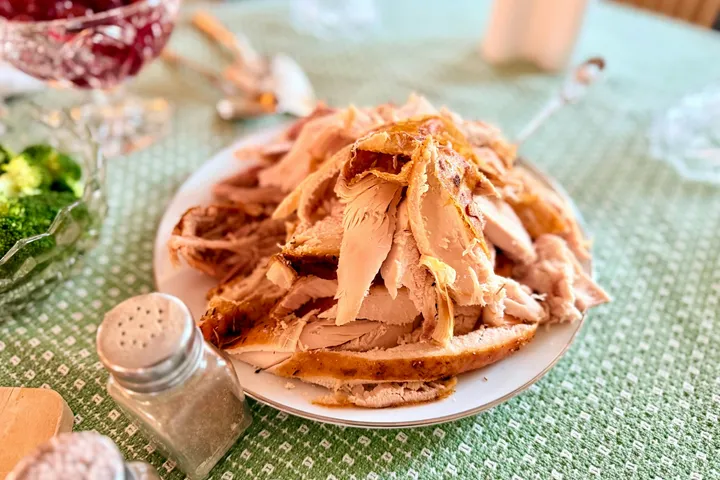
Rest on a board, uncovered or with foil laid loosely on top, for 5 to 10 minutes. Then slice across the grain about a third of an inch thick. Slice it straight off the grill and the juice ends up on the board instead of in the meat.
If you want sauce, brush it on thin in the last 10 minutes with the lid closed; at 250°F the sugar sets without burning. I’d skip it, because the brine and the apple smoke carry the flavor.
Wind, cold and the hot spot
Chicken breast cooks for about an hour, and weather moves the clock by 10 to 15 minutes either way. On a 35°F day with wind the grill cycles harder, the grate swings 20°F around the set point, and breasts that would take 55 minutes can need 72. On a 90°F day in full sun they can be done at 48 minutes. Either way the thermometer knows before the clock does.
Wind is the worst weather for a lean cut, because the fan pulls more air through the cook chamber and moving air dries the surface. Turn the grill’s back to the wind and don’t open the lid for anything beyond the one flip.
Most barrel grills have a hot spot, usually at the end nearest the fire pot or the chimney, and you want the thickest breast sitting there. An oven thermometer at each end during one cook tells you where yours is.
Slicing, meal prep and leftovers
Four breasts feed four. Sliced across the grain, they go on a plate with smoked mac and cheese, which can sit on the upper rack for the whole cook at 250°F, or onto a salad, or into a sandwich with plenty of mayonnaise. It’s worth cooking eight at a time so the extra four become lunches.
For meal prep, cool the breasts and refrigerate them whole, not sliced. A whole breast holds its moisture far better than slices do, and they keep three to four days. Slice them cold, and reheat gently in a covered pan with a splash of stock, or eat them cold. Full power in the microwave dries a breast out in about 90 seconds.
If you’re cooking for a crowd and want white meat that goes further, a smoked turkey breast uses the same 160°F pull and feeds 6 to 8.
Apple pellets and two thermometers
Apple on its own is my wood for chicken breast; the meat is mild, the cook is short, and apple suits both. Pecan is the swap if you want something a touch nuttier. The best pellets for smoking guide covers brands and blends.
This cook lives on the thermometer. A leave-in probe in the thickest breast lets you walk away for the first 45 minutes, and a fast instant-read tells you when each of the others is ready. Both are covered in best wireless meat thermometers.