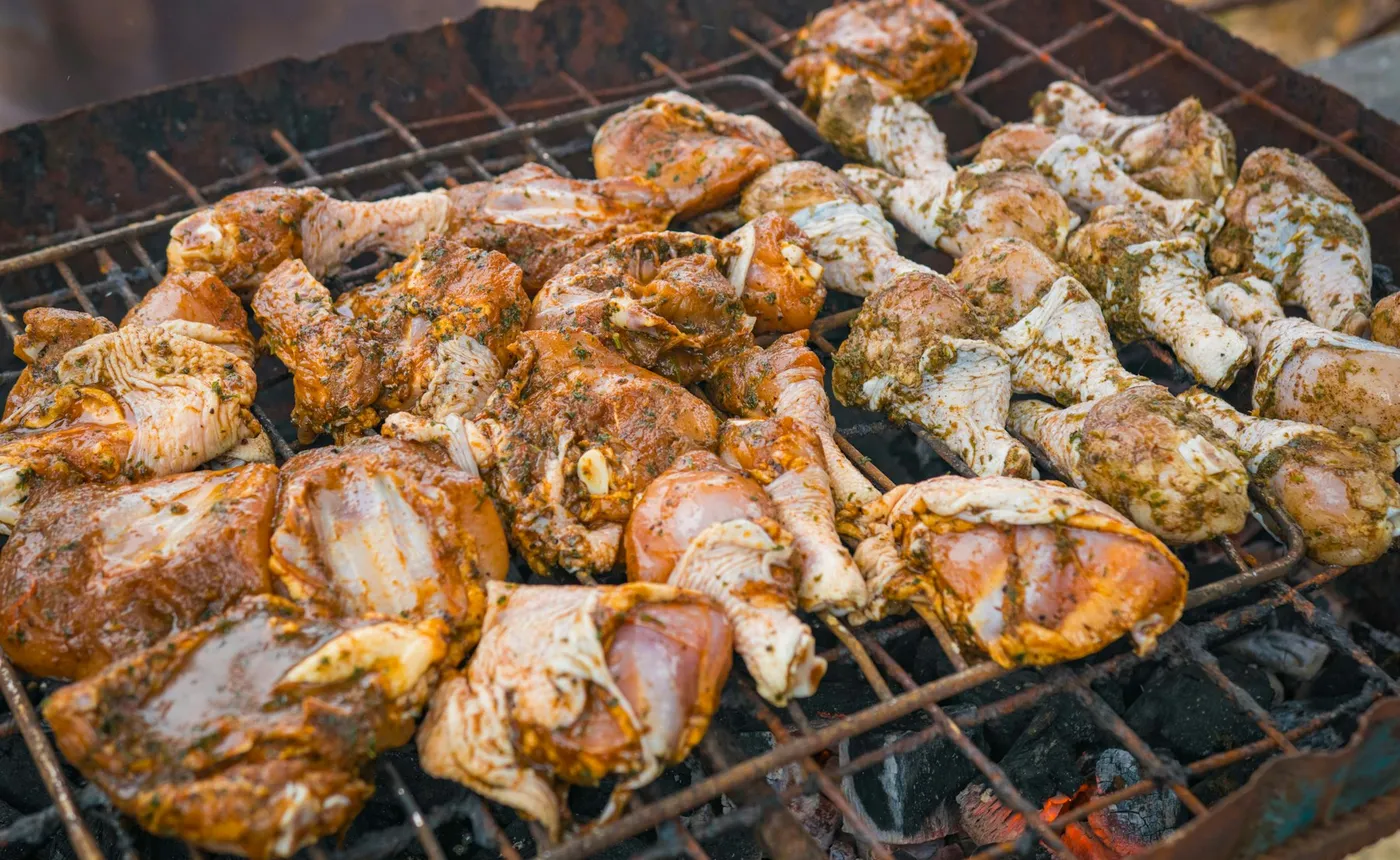
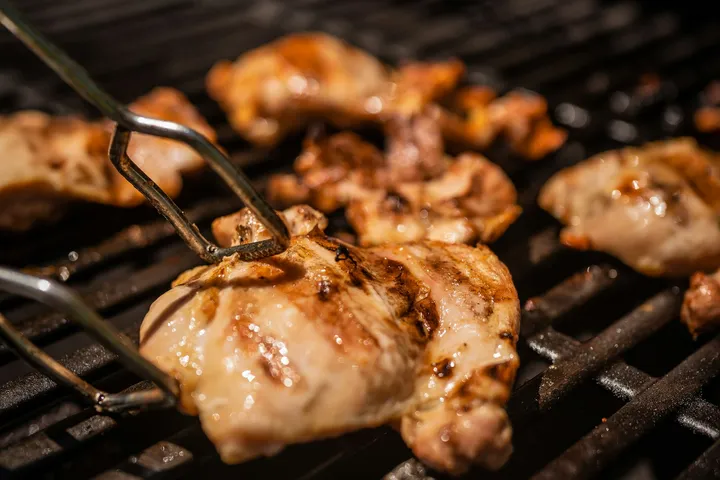
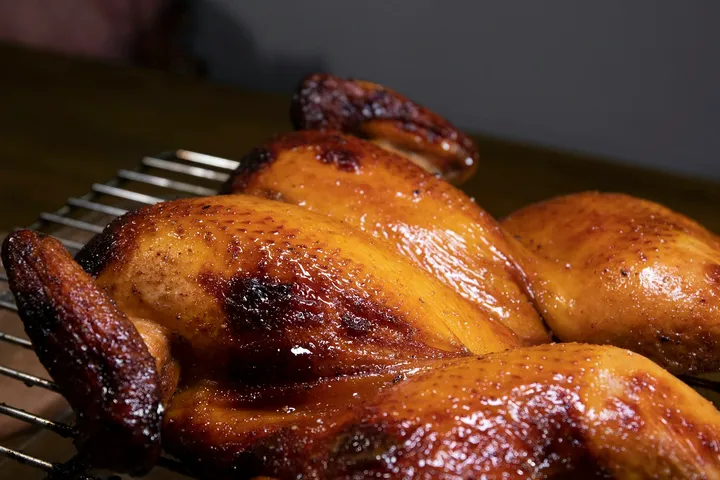
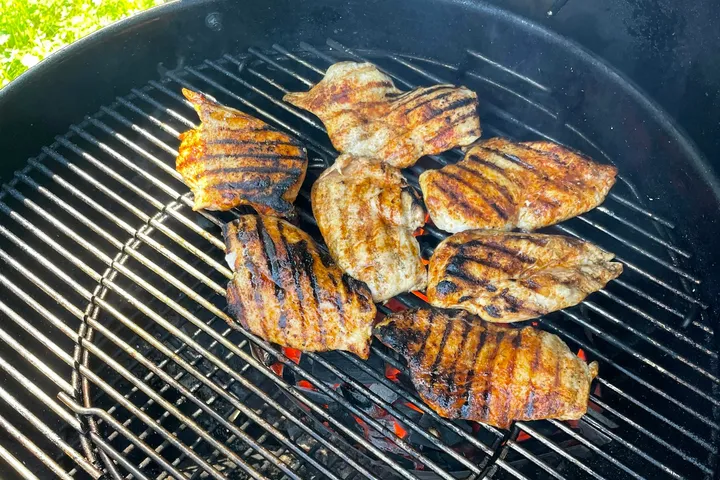
Chicken legs on a pellet grill want 45 minutes at 275°F on hickory, then 15 to 20 minutes with the grill turned up to 400°F, about 70 minutes from grate to plate. They come off at 180°F next to the bone, which is higher than any other piece of the bird, and the reason is what makes them good.
This recipe is written for twelve drumsticks on a Pit Boss. Drumsticks are what I’d hand anyone new to poultry on a pellet grill, because dark meat with a bone through the middle is very hard to dry out. The method matches the chicken thighs page except for the pull temperature, and that one change is most of this page.
A typical first batch of drumsticks spends two hours at 225°F and comes off at 165°F because a chart said so. The skin hangs off them like a loose pale sleeve, and the meat near the bone is pink and stringy. Both problems come from too little heat, and the two-stage cook below fixes both of them.
Drumsticks or leg quarters
Drumsticks of 4 to 5 oz each are the standard pack. Twelve of them is about 3.5 lb and feeds four to six. Pick a pack where the legs are close in size, because a 3 oz leg and a 6 oz leg on the same grate finish 15 minutes apart. The skin should cover the whole meaty end; packs where it’s been pulled back to a strip dry out on top.
Leg quarters, the thigh and drumstick still joined, use the same method at 10 to 12 oz each. They need an extra 15 minutes in the 275°F stage, and if your store carries them they’re often the better buy per pound. Four quarters feed four.
| Cut |
Size |
Smoke stage |
Feeds |
| Drumsticks |
4 to 5 oz each |
45 minutes at 275°F |
12 legs for 4 to 6 |
| Leg quarters |
10 to 12 oz each |
60 minutes at 275°F |
4 quarters for 4 |
| Thighs only |
6 to 8 oz each |
45 minutes at 275°F |
See the thighs page |
Frozen drumsticks are fine if they’re thawed fully in the fridge and dried hard. Legs hold a lot of water under the skin, and every bit of it has to come off before the grill.
How long chicken legs take
| Legs |
Smoke stage |
Crisp stage |
Total |
Pull at |
| 6 drumsticks, 4 to 5 oz |
275°F, 40 min |
400°F, 15 min |
55 to 65 min |
180°F |
| 12 drumsticks, 4 to 5 oz |
275°F, 45 min |
400°F, 15 to 20 min |
65 to 75 min |
180°F |
| 18 drumsticks, two grates |
275°F, 50 min |
400°F, 20 to 25 min |
75 to 90 min |
180°F |
| 4 leg quarters, 10 to 12 oz |
275°F, 60 min |
400°F, 20 min |
80 to 90 min |
180°F |
| 12 drumsticks, all at 350°F |
350°F, 45 to 55 min |
none |
45 to 55 min |
180°F |
| 12 drumsticks, all at 250°F (not recommended) |
250°F, 2 hours |
none |
2 hours |
180°F, soft skin |
Totals include the 10 minutes or so the grill takes to climb from 275°F to 400°F with the lid shut. Cold days add 10 to 15 minutes to the crisp stage. For a big batch, the smoke time calculator will give you a starting number.
If you’re short on time, the 350°F row is honest. The skin still crisps and the legs still hit 180°F; you get less smoke flavor and save about 20 minutes.
Skin up, rub on, fridge
Pat the legs dry with paper towels, all the way around each one. The skin is usually bunched toward the thin end, so pull it up over the meaty end until it covers the leg in a single layer. Skin folded over on itself stays soft in the fold. Trim off any loose flaps.
Coat the legs lightly with a tablespoon of olive oil, enough to hold the rub, and season every side with the salt, pepper, paprika, garlic powder, onion powder, chili powder and a teaspoon of brown sugar. Shake it on from a jar held about a foot up so it lands evenly. A gallon zip bag with the rub in it, three legs at a time, works and makes less mess. Leftover rub goes in the trash, since it’s touched raw chicken.
The sugar stays at a teaspoon so it doesn’t burn at 400°F. For a sweeter leg, get it from the sauce at the end.
Set the legs skin up on a rack over a sheet pan and leave them uncovered in the fridge for at least an hour, overnight if you can. The skin dries from shiny to matte, and matte skin is what crisps. When you’re cooking in an hour, an hour is enough.
No brine. Drumsticks have enough fat and connective tissue to stay juicy, and brined skin holds the water you’re trying to get rid of.
The two-stage cook
Hickory goes in the hopper. Legs get 45 minutes of real smoke, and dark meat is strong enough to carry hickory without being buried by it. Apple or cherry is too soft here. If you want it stronger still, mesquite on drumsticks is one of the few places I’d use it on chicken.
Set 275°F and let the grill hold for 10 minutes after the controller says it’s ready. The legs go on the main grate with an inch between them, thick ends pointing toward the hot end. The gap matters, because legs packed against each other trap steam and the skin on the touching sides never sets.
Close the lid for 45 minutes and don’t turn them. The bone and fat shield the meat, and the skin on top needs steady heat to dry out. Every look costs about 25°F and a few minutes of recovery.
Then, without opening the lid, set the controller to 400°F. The grill takes about 10 minutes to climb and the legs keep cooking on the way up. Once it’s there, give them 15 to 20 minutes, turning each leg once at the halfway point and swapping the hot-end legs with the cool-end ones.
Both stages are about the skin. Chicken skin is collagen and water over a layer of fat, and below roughly 300°F the fat doesn’t render and the water can’t leave fast enough, so the skin goes rubbery and extra time at 225°F won’t change it. At 400°F the fat melts out, the moisture cooks off, and the skin tightens and browns. The low stage puts smoke in the meat and the high stage finishes the skin, and skipping either one costs you half the result.
Pit tip: Do the crisp stage on the main grate. It’s tempting to move the legs to the upper rack for the finish, on the idea that they’ll brown faster up near the lid. After 20 minutes up there the skin is still tan and soft, because the upper rack sits in air that’s already given up its heat. Use the upper rack for overflow during the 275°F stage on a big batch, then bring everything down for the 400°F finish.
| Problem |
Fix |
| Skin tan and soft after 20 minutes at 400°F |
Legs are on the upper rack or the grill is running cold; move them down and give 5 to 10 more minutes |
| Undersides scorching |
They’re over the fire pot; turn early and move toward the cool end |
| Small legs done, biggest at 172°F |
Pull the small ones and give the big one 5 more minutes |
| Sauce turned black |
It went on too early; brush it on only in the last 5 minutes |
180°F at the bone
Pull the legs at 180°F, probed in the thickest part of the biggest drumstick, alongside the bone without touching it. That’s higher than the thigh number on this site and well above the 165°F everyone quotes for chicken. A drumstick is the hardest-working muscle on the bird, and it’s full of tendons and connective tissue that run the length of the bone. At 165°F it’s safe but chewy, and the meat near the bone looks pink and clings. By 180°F that tissue has softened into gelatin and the meat comes off the bone in one piece. Drumsticks at 185°F are still juicy, since dark meat has the fat to handle it.
Check more than one leg. The ones at the hot end will usually be ahead of the rest.
Without a thermometer, twist the bone. On a done drumstick it turns in the meat, and the meat has pulled back from the knuckle end by about a quarter inch. That’s a sign to go find the thermometer, not a replacement for it.
Sauce goes on in the last 5 minutes if you want it, brushed thin with the lid shut so it tacks up; any longer at 400°F and the sugar burns black. Rest the legs 5 minutes on a board and serve them, since the skin is at its best right away.
Cold, wind and pellet burn
The crisp stage is the part weather gets into. On a 30°F day with wind, a pellet grill set to 400°F may only hold 360°F at the grate, and the skin takes 10 extra minutes to brown. Set the controller to 425°F in the cold and go by the color.
High heat in cold air burns pellets fast. On a 48°F day with a light wind, expect about 2.5 lb of pellets for the whole cook; in a January wind I’d expect closer to 4 lb. That’s still a small dent in a bag, but a hopper that looked fine at the start can run low right as you turn it up to 400°F, so fill it before you begin.
On a hot day the climb to 400°F is quick, and legs over the fire pot can scorch underneath before the skin on top is done. Turn them early and move them toward the cool end.
Most pellet grills have a hot end and a cool end, and drumsticks are small enough to show it. On a Pit Boss it’s usually the hopper side: AmazingRibs measured a Pit Boss 820 about 20°F hotter on the left at 225°F, and the gap more than doubled at the top setting. Put the biggest legs there and shuffle once.
Feeding a crowd and the leftovers
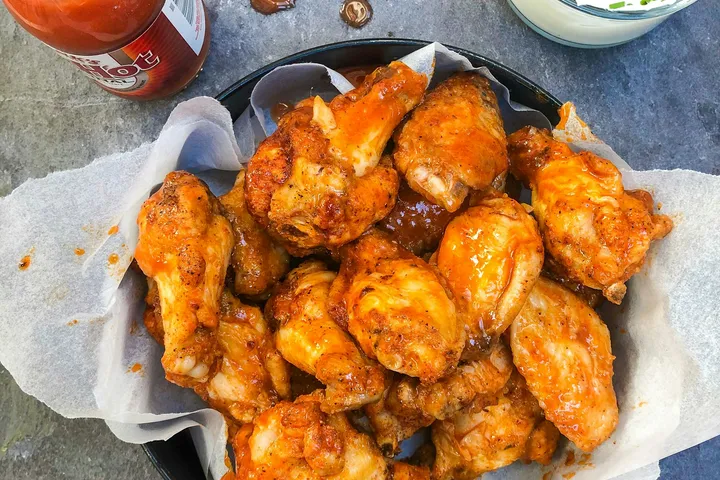
Twelve drumsticks feed four to six, two or three each, with sides. They want something sharp next to them, like slaw, pickles or a vinegar sauce. Smoked mac and cheese fits on the upper rack through the 275°F stage and comes off before the crisp stage. For a party, a batch of smoked chicken wings on the other half of the grate runs on the same two stages and nearly the same clock.
Leftovers keep three to four days in the fridge. Reheat them on a rack on the grill or in a 400°F oven for 10 minutes and the skin comes most of the way back. The microwave turns the skin rubbery in about a minute. Cold drumsticks eaten standing at the open fridge are what happens to most of them anyway.
Hickory and an instant-read
Hickory on its own is my wood for chicken legs, because the meat is dark enough to carry it and the smoke stage is short. Cut it with cherry if you want darker skin. The best pellets for smoking guide covers brands and which bags are mostly oak filler.
Legs need an instant-read thermometer with a thin tip that slides in alongside the bone, since a leave-in probe has nowhere useful to sit in a drumstick. The ones I’d buy are in best wireless meat thermometers.