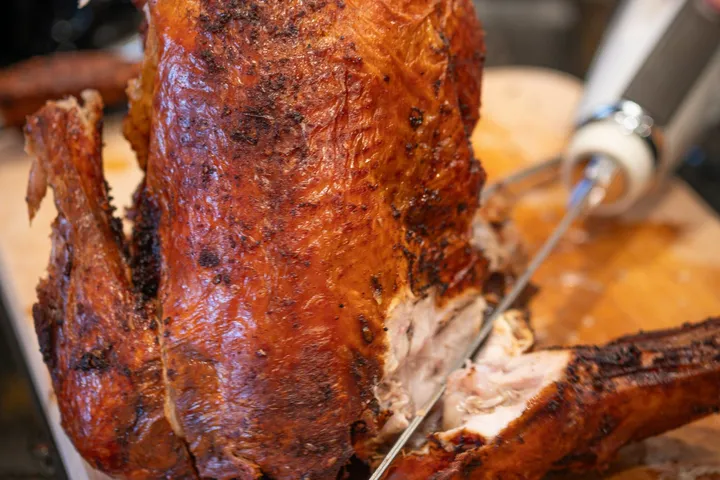
Spatchcock turkey on a pellet grill
Cook the flattened bird at 300°F on cherry and hickory pellets; a 13 lb turkey takes about 2 hours. Pull when the breast reads 162°F and the thigh 175°F, then rest it 20 minutes.
- Grill
- 300°F
- Pull at
- Time
- 2¾ hr
Smoking a turkey on a pellet grill at 300°F takes about 13 minutes a pound. Brine it, burn cherry and pecan, pull at 162°F breast and 175°F thigh.
Each recipe gives the pellets, grill temperature, pull temperature and time first. Pull temperatures meet USDA minimums or the doneness barbecue cooks aim for, whichever is higher. Our own cook photos are being added page by page; current photos are credited stock.
Set the grill to 300°F with cherry and pecan pellets and plan on about 3 hours 15 minutes for a brined 14 lb turkey. Pull when the breast reads 162°F and the thigh 175°F, then rest it 30 minutes.
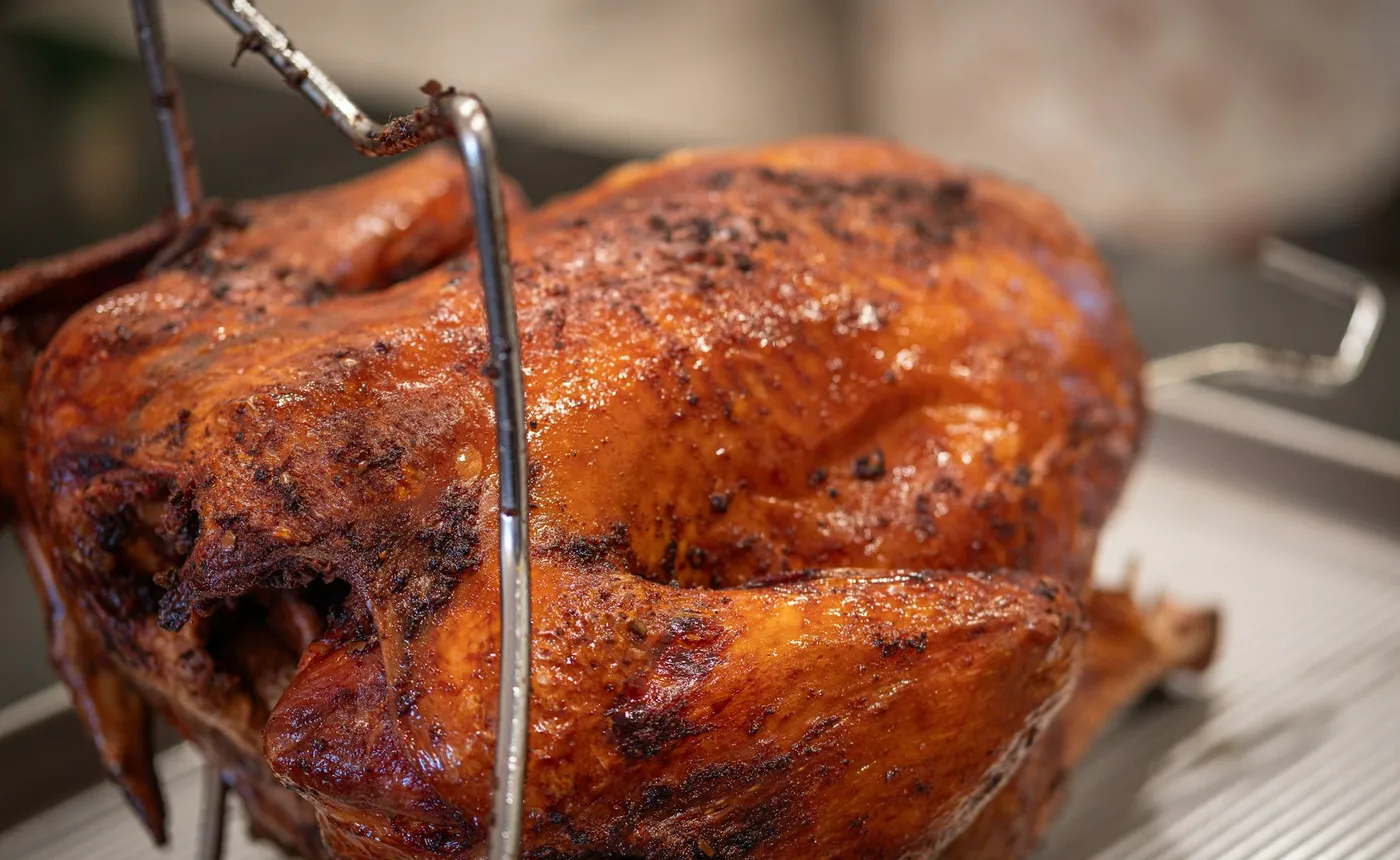
Run the pellet grill at 300°F and a brined 12 to 14 lb turkey takes about 13 minutes a pound, which puts a 14 lb bird at roughly 3 hours 15 minutes. Pull it when the breast reads 162°F and the thigh 175°F, rest it half an hour, and the breast coasts up to 165°F on the board.
This recipe is written for a Traeger, with cherry and pecan pellets mixed half and half, butter pushed under the breast skin and a pan of stock under the rack. The timings assume a grey afternoon in the mid 40s with a light wind, which is about what most of the country sees on Thanksgiving week. It’s the cook in the poultry recipes that people get most nervous about, mostly because the whole family is watching.
The usual first-turkey mistake is running it at 225°F, because that’s what works for pork shoulder. Six hours later the breast is fine and the skin is a grey, damp sheet that everyone peels off and leaves on the plate. At 300°F the skin comes out brown and thin enough to bite through, and every number on this page follows from that change.
A 12 to 14 lb bird is the size I’d shop for. It fits a standard pellet grill with the lid closed, cooks evenly from front to back, and feeds 10 to 12 people. Bigger birds are where whole-turkey smoking gets awkward, because the breast hits its number long before the thighs do.
| Bird weight | What I’d do |
|---|---|
| 10 to 14 lb | Smoke it whole at 300°F, exactly as written here |
| 14 to 16 lb | Whole is still fine; turn the pan twice instead of once |
| Over 16 lb | Spatchcock it or buy two smaller birds |
| White meat only | Cook a smoked turkey breast instead, which feeds 6 |
Read the label before you buy brine supplies. Supermarket turkeys marked “enhanced”, “basted” or “self-basting” have been injected with a salt solution of up to 8 percent, and brining one of those turns the breast into something closer to deli ham. You want a bird marked “no solution added”, or a fresh one from a butcher.
Thawing takes longer than anyone budgets for. A frozen turkey needs a full day in the fridge for every 4 to 5 lb, so a 14 lb bird goes in the fridge three days before the brine starts. If the cavity still has ice in it, wait; brine can’t reach frozen meat, and the outside oversalts while the middle thaws.
| Turkey weight | Grill temp | Approximate time | Pull at |
|---|---|---|---|
| 10 to 12 lb | 300°F | 2.5 to 3 hours | 162°F breast, 175°F thigh |
| 12 to 14 lb | 300°F | 3 to 3.5 hours | 162°F breast, 175°F thigh |
| 14 to 16 lb | 300°F | 3.5 to 4 hours | 162°F breast, 175°F thigh |
| 16 to 18 lb | 300°F | 4 to 4.5 hours | 162°F breast, 175°F thigh |
| 18 to 20 lb | 300°F | 4.5 to 5 hours | 162°F breast, 175°F thigh |
| 12 to 14 lb | 325°F | 2.5 to 3 hours | 162°F breast, 175°F thigh |
Those times assume the bird went on straight from the fridge and the grill held 300°F at the grate on a day above 40°F. A cold, windy afternoon adds 20 to 30 minutes. For a weight that isn’t on the table, the smoke time calculator gives a starting estimate.
To carve at 4:00, put a 14 lb bird on by 11:45. That covers 3 hours 15 minutes on the grill, a 30 minute rest and a 30 minute cushion, because an early turkey can sit under foil for an hour and lose nothing, while a late one leaves the table eating rolls.
The brine is a cup of kosher salt and half a cup of brown sugar dissolved in 2 quarts of hot water, with the bay leaves, peppercorns and halved garlic, then topped up with the rest of the 2 gallons cold. Chill it before the turkey goes in. A 5 gallon food-safe bucket or a big brining bag holds a 14 lb bird, and a cooler with ice works if the brine stays under 40°F. Give it 12 to 24 hours; past that the texture turns spongy.
| Wet brine | Dry brine | |
|---|---|---|
| Salt | 1 cup kosher salt in 2 gallons of water | About 3 tablespoons kosher salt rubbed on |
| Time | 12 to 24 hours | Overnight, 12 to 24 hours |
| Space | A 5 gallon bucket or a cooler | A rack and a sheet pan in the fridge |
| Skin | Needs 4 hours of air drying after | Dries while it brines |
When it comes out, drain the cavity and pat the bird dry. Skip the rinse; a brine this mild doesn’t leave a salty crust, and rinsing raw poultry in the sink mostly sprays it around the kitchen. Then set it on a rack over a sheet pan, uncovered, in the fridge for at least 4 hours. The skin goes from shiny to papery and slightly tacky, and that dry surface is what browns later.
Before the grill, soften the butter and slide your fingers under the breast skin from the neck end, loosening it without tearing. Push half the butter against the meat and rub the rest over the outside. Season with the pepper, garlic powder, thyme and paprika, and leave salt out of the rub entirely, since the brine already handled it. The onion, lemon and fresh thyme go in the cavity for aroma.
Watch out: Don’t put bread stuffing inside a smoked turkey. The stuffing has to reach 165°F to be safe, and by the time the center of the cavity gets there the breast is well past 175°F. Bake the stuffing in a pan on the upper rack instead.
Fill the hopper with cherry and pecan, half and half, and fill it to the top. Set 300°F and leave the lid shut for 15 minutes after the controller says it’s there, because the grate always lags the display. Most pellet grills run hotter at one end of the grate. On the Traeger Pro 575 that AmazingRibs tested, it was the left, chimney side, about 10°F hotter at low settings and more as the heat climbed, so find your hot end and put the bird on with the legs pointed toward it, where the thighs can use the extra heat.
The turkey sits breast up on a wire rack inside a disposable foil pan with 2 cups of stock in the bottom. The pan catches drippings for gravy and keeps fat off the heat deflector, where it would smoke and flare. Push a leave-in probe into the thickest part of the breast, angled in from the side and halfway down, not touching the breastbone. A second probe goes in the thigh, near the bone but not against it.
Then close the lid for two hours and leave it alone. Each time you open it the grill drops about 30°F and the skin stops rendering while it recovers.
The reason for 300°F rather than a classic low smoke is the skin. Turkey skin is mostly water and collagen sitting on a layer of fat. At 225°F that fat never gets hot enough to melt out, and the water leaves so slowly that the skin turns rubbery instead of crisp. At 300°F the fat renders, the moisture cooks off, and the skin tightens and browns while the meat underneath is still in a safe, juicy range. If you want a heavier smoke, run 225°F for the first 45 minutes and then turn it up to 300°F, and add 30 minutes to the plan.
At two hours, rotate the pan end for end and look at the probes. A 14 lb bird usually reads 120 to 130°F in the breast at this point. If the breast skin is already dark and the legs are pale, tear off a loose sheet of foil and lay it over the breast only, like a sunshade, not a wrap.
The classic probing mistake is a tip resting against the breastbone, which heats faster than the meat. It can read 165°F while the breast an inch away is still at 148°F, and then the bird goes back on the grill in pieces while everyone waits. Probe from the side, halfway into the thickest part, and confirm with an instant-read in two other spots before anything leaves the grate.
| What you see | Likely cause | What to do |
|---|---|---|
| Breast at 162°F, thighs stuck at 165°F | Thighs sat at the cool end | Carve the breast off, put the leg quarters back on for 15 minutes |
| Skin pale and soft at 2.5 hours | Grill running cold or skin was wet going on | Raise to 325°F for the last 30 minutes |
| Breast skin dark at 2 hours | Breast is over a hot spot | Loose foil over the breast, rotate the pan |
| Grill temperature sliding down | Hopper low or pellets bridged | Stir the pellets and top up the hopper |
| Running an hour behind | Cold, wind or a bigger bird than labeled | Go to 325°F and keep the lid shut |
Pull it when the breast reads 162°F in the thickest part and the thigh reads 175°F near the bone. A big bird carries over 3 to 5°F while it rests, so the breast lands at 165°F, which is the USDA number and also the point where the white meat is still moist. At 170°F the breast starts to dry; at 180°F you’ll see a lot of gravy being poured.
The thighs want more heat than the breast, since dark meat has connective tissue that doesn’t soften until about 175°F, and I’m happier at 180°F. If they lag, use the carve-and-return move from the table above; nobody can tell on the platter.
Rest the bird under a loose tent of foil for 30 minutes, or 45 for an 18 lb turkey. Tight foil traps steam and softens the skin you spent three hours building. For carving, take each breast lobe off the bone in one piece and slice it across the grain on the board, then split the thighs from the drumsticks. You get neater slices that way than by carving on the bird.
Thanksgiving is a cold-weather cook for most of the US, and a pellet grill holding 300°F in 30°F air behaves differently from the same grill in July. The controller feeds harder to keep up and the grate swings wider on every cycle. On a 44°F day with a light wind, expect a 14 lb bird to burn about 7 lb of pellets over three and a half hours. On a 25°F day with wind I’d plan on 9 to 10 lb.
| Outside conditions | Preheat time | Pellets for a 14 lb bird | Extra cook time |
|---|---|---|---|
| Above 45°F, calm | 15 minutes | Under 7 lb | None |
| 44°F, light wind | 15 to 20 minutes | About 7 lb | Little or none |
| 25 to 30°F with wind | 20 to 25 minutes | 9 to 10 lb | 20 to 30 minutes |
Run the pellet calculator the night before and keep a full bag next to the grill, because a hopper running dry at hour three is a bad way to find out your estimate was low. Park the grill out of the wind with the hopper side downwind, and use an insulated grill blanket below 40°F if you own one. A whole turkey is big enough to sit over the hot end and the cool end at once, which is why the turn at hour two matters.
A 14 lb turkey serves 10 to 12 with sides, or 8 if you want leftovers worth having. The drippings in the pan are smoky and already salted by the brine, so make gravy with them and taste before adding any salt. Smoked mac and cheese can go on the upper rack for the last hour at 300°F, and a smoked ham wants the same temperature, so both fit on one big grill for a large table.
Leftover turkey keeps three to four days in the fridge. Slice the breast and store it with some of its juice or a splash of stock so it doesn’t dry out, and reheat it covered at 300°F for about 15 minutes.
Cherry and pecan, half and half, is the mix I’d put in the hopper for any turkey. Cherry does the color and pecan carries enough smoke to taste under gravy. With only one bag in the garage, use pecan or apple on its own. The best pellets for smoking guide covers which brands are mostly oak filler with flavor oil.
This is the cook where a two-probe thermometer pays for itself, one in the breast and one in the thigh, plus an instant-read to check the other side before you pull. The models I’d buy for that job are in best wireless meat thermometers.
thepelletpit.com/recipes/turkey/
Mix and chill the brine
Stir the salt and brown sugar into 2 quarts of hot water with the bay leaves, peppercorns and garlic until dissolved, then add the rest of the cold water. Get it below 40°F before the turkey goes in.
Brine 12 to 24 hours
Submerge the turkey in a food-safe bucket or brining bag in the fridge, or in a cooler kept under 40°F with ice. Take it out by 24 hours; longer and the meat turns spongy.
Dry the skin
Lift the bird out, drain the cavity and pat it dry inside and out with paper towels. Leave it uncovered on a rack over a sheet pan in the fridge for at least 4 hours, overnight if you can.
Butter and rub
Push half the butter under the breast skin and rub the rest over the outside. Season with the pepper, garlic powder, thyme and paprika (no salt), and put the onion, lemon and thyme in the cavity.
Preheat to 300°F
Fill the hopper with cherry and pecan pellets, set the grill to 300°F and give it 15 more minutes with the lid shut after it reports ready.
Set the pan and probes
Set the turkey breast side up on a rack inside a foil pan with the stock in the bottom. Push a probe into the thickest part of the breast from the side, clear of the bone, and a second one into a thigh if you have it.
Two hours with the lid shut
Put the pan on the grate with the legs toward the hot end and close the lid for 2 hours. At the 2 hour mark, turn the pan end for end.
Watch the last hour
Check the probes every 20 minutes from hour 2. If the breast skin is darker than the legs, lay a loose sheet of foil over the breast only.
Pull, rest and carve
Pull when the breast reads 162°F and the thigh 175°F, and confirm with an instant-read in two other spots. Rest 30 minutes under loose foil, then carve the breast off the bone in whole lobes.
Plan on 12 to 15 minutes a pound at 300°F, so a 14 lb bird takes about 3 hours 15 minutes. At 325°F it drops to roughly 11 minutes a pound. Start checking the breast an hour before you expect it to be done and go by the thermometer, not the clock.
300°F. That's hot enough to render the fat under the skin so it browns and crisps, and gentle enough that the breast doesn't dry out while the thighs catch up. Below 275°F the skin comes out rubbery however long you leave it.
Yes, unless the label says enhanced, basted or self-basting, which means it was injected with a salt solution at the plant. A 12 to 24 hour wet brine with a cup of kosher salt in 2 gallons of water is the biggest single reason a smoked breast stays juicy. A dry brine overnight gets you most of the way with no bucket.
Cherry and pecan, half and half. Cherry turns the skin a deep red-brown and pecan adds a mild, nutty smoke that suits a three hour cook. Straight hickory works if that's what you have; I'd leave mesquite in the garage for turkey.
No. A whole 12 to 14 lb bird at 300°F cooks evenly enough. Past 16 lb I'd spatchcock, because flattening gets the breast and thighs done within minutes of each other and cuts the cook to about 2 hours.
Cook the flattened bird at 300°F on cherry and hickory pellets; a 13 lb turkey takes about 2 hours. Pull when the breast reads 162°F and the thigh 175°F, then rest it 20 minutes.
Smoke at 250°F on apple and hickory pellets, then turn the grill up to 375°F when the breast reads 150°F. A 6 to 7 lb bone-in breast takes about 2.5 hours; pull at 160°F and rest 20 minutes to reach 165°F.
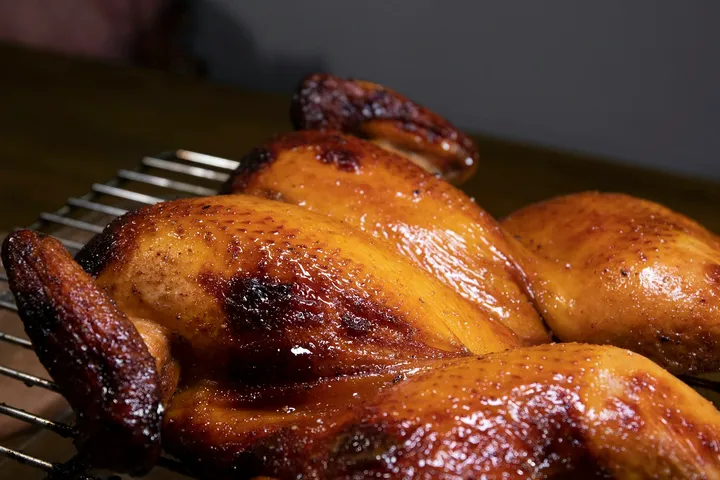
Cook a 4 to 5 lb chicken at 350°F on pecan pellets for 70 to 85 minutes, or 50 to 60 minutes spatchcocked. Pull when the breast reads 160°F and the thigh at least 175°F, then rest it 15 minutes.
Warm a fully cooked 8 lb bone-in ham at 225°F on half cherry, half maple pellets for about 2.5 to 3 hours, glazing at 120°F and 130°F and turning the grill to 300°F for the finish. Pull at 140°F; plan about 3.5 hours including a 20 minute rest.