Pull a smoked prime rib off the pellet grill at 120 to 125°F in the center, rest it while the grill climbs to 450°F, then sear it for about 10 minutes and rest it again. At 225°F on oak and cherry pellets, figure about 35 minutes a pound for the smoke stage. On a 40°F day a 7 lb, 3 bone roast needs a little over 4 hours to that first pull and should finish around 134°F after the last rest.
This recipe is written for a Traeger, and it’s worth a practice run before the holiday dinner it’s meant for. It’s the most expensive cut in the beef recipes on this site, so the method is built around control. Smoking low and searing last means the roast climbs slowly and you can stop it within 2 or 3 degrees of where you want it, which an oven at 350°F won’t let you do.
The classic way to ruin a smoked prime rib is a probe tip resting against a rib bone, which can leave the center about 12 degrees under target. How to spot it, and where the probe should go, comes further down.
Choosing a standing rib roast
Ask for a bone-in standing rib roast from the loin end, sometimes called the first cut or small end (ribs 10 to 12). It has a bigger eye of meat and less fat than the chuck end. Count one bone for every two people: a 3 bone roast of about 7 lb feeds six with leftovers, and a 4 bone roast feeds eight.
Choice grade is what I’d buy, and it’s fine. Prime costs noticeably more per pound. The extra marbling shows in a cut this lean, but temperature control decides how the roast turns out far more than the grade does.
Buy it bone in. The bones work as a built-in rack and keep the bottom of the roast away from the heat. If you want easy carving, the butcher can cut the bones off and tie them back on, which gives you both. A boneless roast cooks 10 to 15 percent faster; the table has a row for it.
Skip roasts with a thick fat cap unless you plan to trim it. About half an inch is the most that will render in 4 hours at 225°F, and anything thicker stays chewy.
Prime rib smoking time per pound
| Roast |
Grill temp |
Time to 125°F |
Sear |
After the rest |
| 2 bone, about 4.5 lb |
225°F |
2.5 to 3 hours |
8 to 10 min at 450°F |
130 to 135°F |
| 3 bone, about 7 lb |
225°F |
3.5 to 4.5 hours |
10 min at 450°F |
130 to 135°F |
| 4 bone, about 9 lb |
225°F |
4.5 to 5.5 hours |
10 to 12 min at 450°F |
130 to 135°F |
| 5 bone, about 12 lb |
225°F |
6 to 7 hours |
12 min at 450°F |
130 to 135°F |
| Boneless, 5 lb |
225°F |
3 to 3.5 hours |
8 min at 450°F |
130 to 135°F |
| 3 bone, 7 lb |
250°F |
3 to 3.5 hours |
10 min at 450°F |
130 to 135°F |
Those final numbers are medium rare. For medium, pull at 135°F and you’ll finish around 140 to 145°F; for rare, pull at 115°F. The smoke time calculator gives you a start time to plan dinner around, but on this cook the thermometer has the final word.
Pit tip: Start the roast an hour earlier than the table says. A finished prime rib holds well tented on a board for 45 minutes before the sear, and a roast that’s running late leaves you serving dinner at 9 p.m.
Dry brine and herb butter
Salt the roast the night before. Use 1 tablespoon of kosher salt for every 4 lb, mixed with a teaspoon of coarse pepper, and rub it over every surface including the bones. Set it on a rack over a tray, uncovered, in the fridge for 12 to 24 hours. The salt works its way into the meat and the surface dries out, and that dry surface is what gives you a crisp crust later.
An hour before cooking, take the roast out so it loses its chill. Score the fat cap in a diamond pattern about a quarter inch deep, then spread over it 2 tablespoons of softened butter mixed with minced garlic, chopped rosemary and thyme. The scoring lets the butter and smoke get past the fat.
If the butcher didn’t tie the roast, tie it between each bone with butcher’s twine. That keeps the eye round, so the slices come out even and cook at the same rate.
The probe goes in from the end of the roast, running parallel to the bones, with the tip in the center of the eye and at least an inch from any bone. This is the step that goes wrong most often.
Smoking and searing it
Fill the hopper with half oak and half cherry. Oak is clean and neutral, and 4 hours of it won’t bury beef that cost this much. Cherry adds a reddish color to the crust and a little sweetness that goes with the butter and herbs. Hickory will do if it’s what you have, but I’d keep mesquite away from this roast.
Set the Traeger to 225°F and give it 15 minutes after it reports it’s at temperature. Set the roast in the middle of the grate, bone side down and fat side up, with the thicker end toward the hot side. On a Traeger Pro that’s usually the left, chimney end, where AmazingRibs measured the highest grate temperatures. Close the lid.
Then leave it for 2 hours. A rib roast has enough fat to baste itself, so there’s no spritzing or mopping, and each time you open the lid the grill loses about 25°F and needs roughly 10 minutes to recover.
Here’s how the bone mistake plays out. At three and a half hours the probe reads 125°F, so you pull, rest, sear and carve in front of six people, and the center reads 112°F. The ends are fine; the middle is rarer than anyone wanted. The probe tip was sitting against a rib bone, and bone heats faster than the meat around it. Probe from the end into the center of the eye, and from hour three double-check with an instant-read in two spots, the center and about 2 inches from one end. Trust whichever number is lower.
When the center reaches 120 to 125°F, move the roast to a board and tent it loosely with foil. Turn the grill up to 450°F with the lid closed, or to its maximum if that’s lower; most Traegers top out at 500°F. Getting there takes 15 to 20 minutes, which is about the rest the roast needs anyway. During that time the internal temperature rises 3 to 5°F and then begins to drop.
Put the roast back on and sear it with the lid down for 8 to 12 minutes, turning it once halfway so both the fat cap and the bone side color. You want a crust that’s dark and crackly. The center rises about 5°F more during the sear. You can sear the cut faces in a cast iron pan on the grate instead, but searing the whole roast with the lid closed is easier and there’s less to clean up.
When to pull prime rib for medium rare
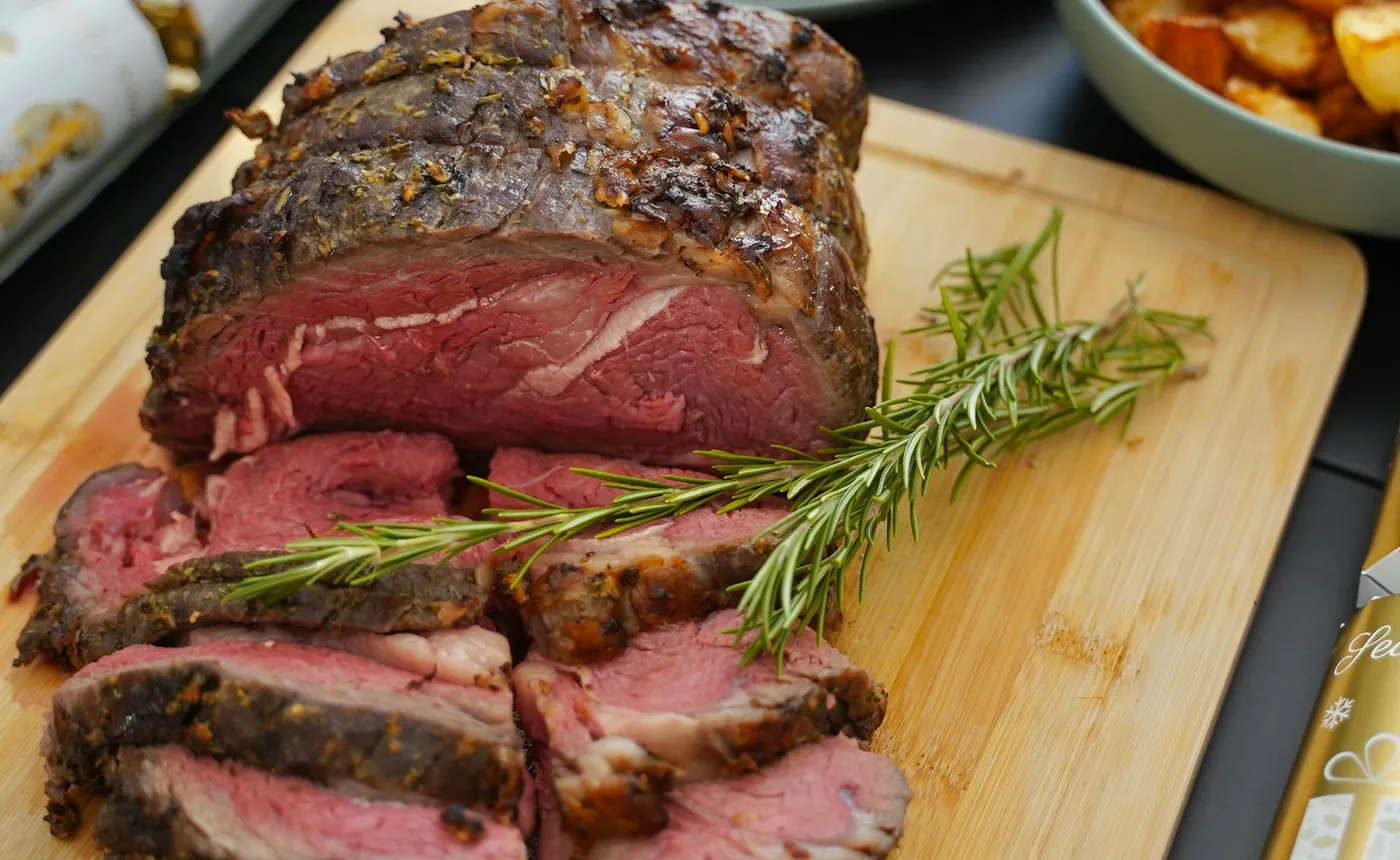
For medium rare, pull from the smoke at 120 to 125°F. After the two rests and the sear the center will read 130 to 135°F and the slice will be pink nearly out to the crust. Pull at 130 to 135°F for medium, or 115°F for rare.
A reverse-seared roast carries over less than an oven roast, because the outside was never blasted with high heat for long. That’s why you can pull it closer to the target. If you’re unsure, still pull early. A slice that’s too rare can go back on the grill for a minute, and one that’s overdone can’t be fixed.
After the sear, rest the roast uncovered on a board for 20 minutes. Covering it now would steam the crust soft. To carve, run the knife along the curve of the bones to take them off in one piece, lay the roast flat, and cut half inch slices across the grain.
Smoking prime rib in cold weather
Most people cook prime rib in winter, so plan for it. At 28°F with a light wind, expect a 7 lb roast to need about 4 hours 50 minutes to reach 125°F instead of 4 hours 10 minutes, and the climb to 450°F for the sear can take 25 minutes. The grill should still hold its temperature, but it burns more pellets doing it, roughly 9 lb over the whole cook against 6 lb on a mild day, so put the grill out of the wind and check the hopper before you turn it up for the sear.
| Outside temp |
Time to 125°F (7 lb roast) |
Pellets for the whole cook |
| About 40°F |
About 4 hours 10 minutes |
About 6 lb |
| 28°F with wind |
About 4 hours 50 minutes |
About 9 lb |
In summer the same roast at 225°F finishes in about 3 hours 30 minutes and picks up less smoke, because the fire doesn’t have to cycle as often. For more smoke on a warm day, run the first hour at 180°F or on the grill’s smoke setting, then move up to 225°F.
Most pellet grills have a hot side. Keep the thick end of the roast pointed at it and the thin end toward the middle, and the two ends finish closer together.
Serving prime rib and using the leftovers
Serve the roast with horseradish cream (sour cream, prepared horseradish, lemon and salt) and any juice that collected under the rack. Smoked mac and cheese can go on while the roast rests and come off by the time you carve. If the same holiday needs a turkey, pellet grill turkey cooks at a higher temperature, so I smoke it the day before and reheat it.
Leftover prime rib makes a very good roast beef sandwich, sliced thin and cold. Reheating it hot takes it to medium well, so I don’t. If you have to warm it, put the slices in a covered pan with a splash of broth at 250°F for about 10 minutes. The bones go into a stockpot with an onion and water.
For a cheaper weekend on the same grill, smoked chuck roast uses a similar setup and needs far less attention. When you’re ready for a longer cook, pellet grill brisket uses the same careful probing over 10 hours instead of 4.
Pellets and thermometers for prime rib
Oak and cherry, half and half. Oak keeps it clean, cherry colors the crust, and neither is strong enough to compete with good beef. Pecan is a fine replacement for the cherry. Which pellet bags burn clean, and which leave the hopper full of dust, is in best pellets for smoking.
This is the cook a good thermometer pays for. A leave-in probe placed correctly gets you to the first pull, and an instant-read checked in two spots confirms it before you commit to the sear, because being 10°F off on a roast this expensive ruins the evening. The ones I trust are in best wireless meat thermometers.