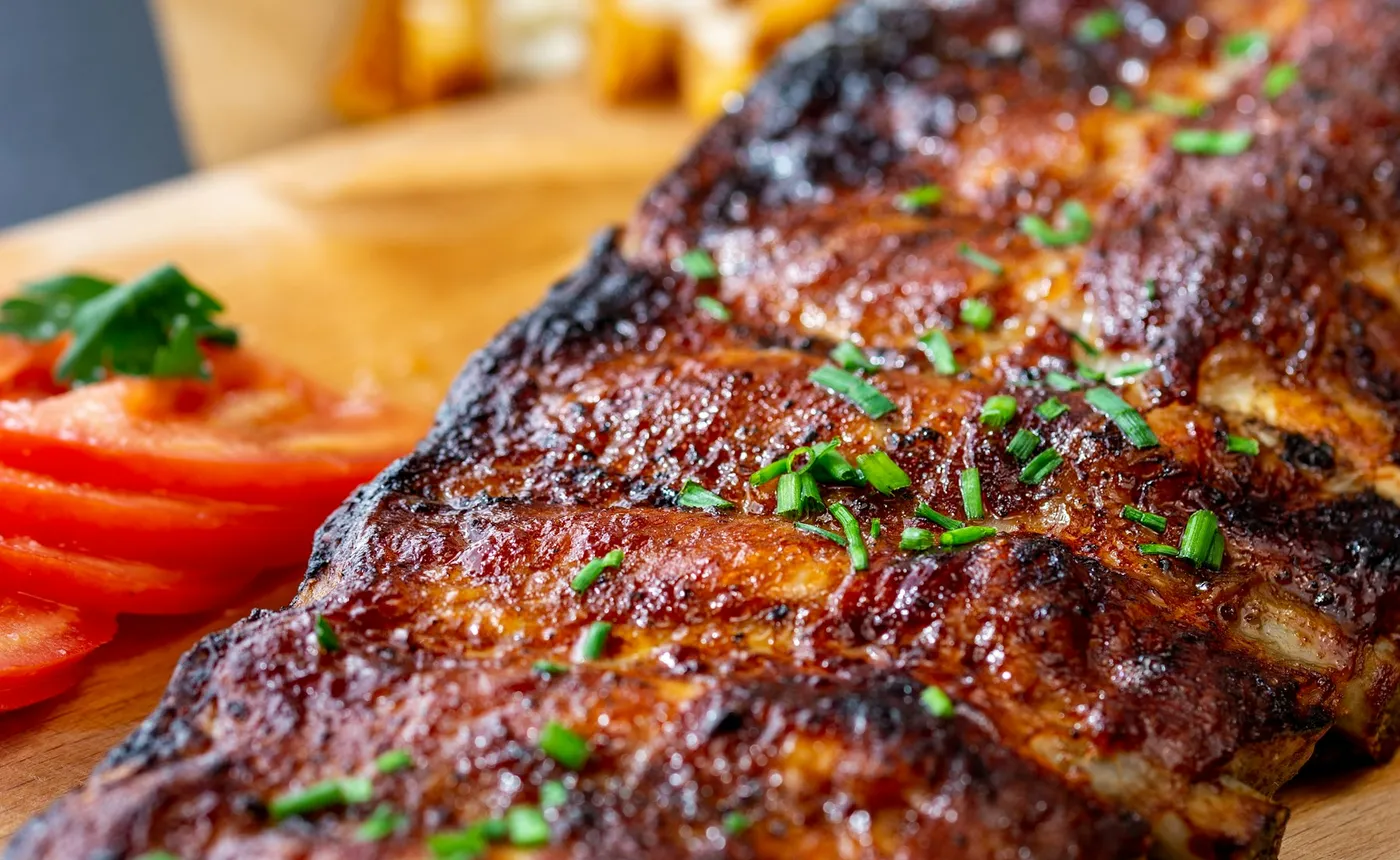
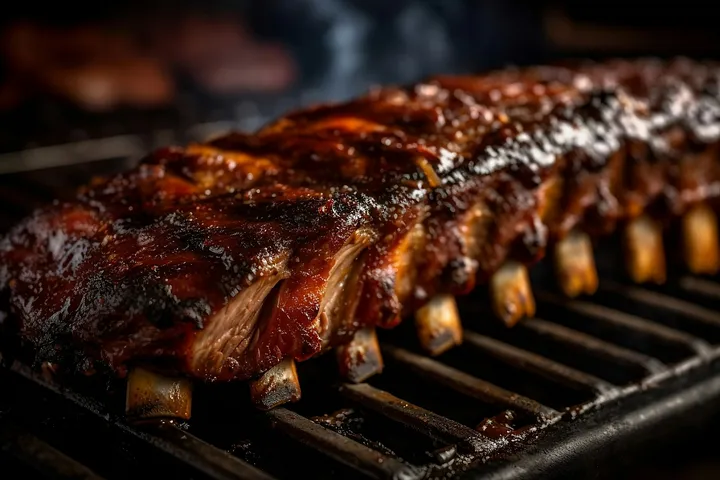
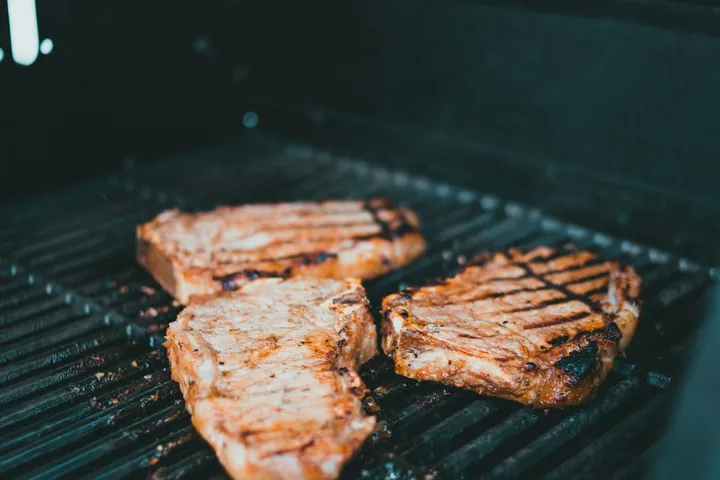
Baby back ribs need about 4 hours at 250°F on a pellet grill, roughly an hour less than spare ribs, and they’re done when a probe slides between the bones at 195 to 200°F and the rack bends almost in half. Because they’re lean, they also go from done to mushy faster than spares, and that’s where the popular 3-2-1 method catches people out.
This recipe is written for a Camp Chef running half apple and half hickory pellets. Two 2 lb racks that go on at 1 p.m. are usually ready a little after 5. This is the same approach as the St. Louis ribs recipe with the clock turned down, and among the pork recipes on the site it’s the quickest way to a full rack.
The usual first-timer mistake is following 3-2-1 to the minute on baby backs: three hours of smoke, two in foil, one with sauce. By hour five the bones slide out when you pick the rack up, and the meat has the texture of pot roast. On spares that schedule is a reasonable starting point. On baby backs it runs about two hours long.
Buying baby backs (and what loin backs are)
Baby backs come from the top of the rib cage where it meets the spine, under the loin. They’re shorter and curved, and the meat sits on top of the bones instead of between them. A rack weighs 1.5 to 2.5 lb with 10 to 13 bones. Heavier racks, sometimes labeled loin backs, carry a strip of loin along the top and need an extra 30 to 45 minutes.
Pick racks with an even layer of meat across the whole length and no bone showing on the meaty side, because thin spots at one end finish early and dry out. Leave the packages that look grey and wet, along with anything that says “enhanced” or lists a percentage of solution. Those have been injected with salt water.
Two racks fit side by side on most pellet grills, and a Camp Chef 24 takes three with a rib rack. If you’re feeding more than four people, cook three. Leftover baby backs make a good lunch.
|
Baby backs |
St. Louis spares |
| Rack weight |
1.5 to 2.5 lb |
2.5 to 3.5 lb |
| Time at 250°F |
3.5 to 4.5 hours |
4 to 5.5 hours |
| Pull temp |
195 to 200°F |
198 to 203°F |
| Fat |
Lean, meat on top of the bone |
Fattier, meat between the bones |
| Wrap |
Optional, 2-1-0.5 |
Optional, paper at hour 3 |
Baby back rib timing at 225°F, 250°F and 300°F
| Rack |
Grill temp |
Time |
Pull at |
| Baby backs, 1.5 to 1.75 lb |
250°F |
3.5 to 4 hours |
195 to 200°F and bends |
| Baby backs, 2 to 2.25 lb |
250°F |
4 to 4.5 hours |
195 to 200°F and bends |
| Loin backs, 2.5 lb and up |
250°F |
4.5 to 5 hours |
195 to 200°F and bends |
| Baby backs, 2 lb, wrapped 2-1-0.5 |
250°F |
3.5 hours |
200°F |
| Baby backs, 2 lb, no wrap |
225°F |
5 to 5.5 hours |
195 to 200°F and bends |
| Baby backs, 2 lb, hot and fast |
300°F |
2.5 to 3 hours |
195 to 200°F and bends |
Those numbers assume 250°F at the grate on a day above 55°F. Baby backs don’t stall the way a pork butt does, though they often sit around 160°F for 30 to 45 minutes before climbing again. For other rack weights, the smoke time calculator gives a starting figure.
Prep: membrane, mustard and a sweeter rub
The membrane on a baby back is thinner than on spares and tears more easily, so start in the middle rather than at an end. Slide a butter knife under it over one bone, lift, grab it with a paper towel and peel toward each end in turn. If patches stay stuck, score them with the tip of a knife so they don’t cook into a plastic sheet.
Trim the loose flap of meat on the bone side and any hard fat at the corners. That’s usually all a baby back rack needs.
Spread a thin coat of mustard on both sides, then season. This rub is salt, pepper, paprika, brown sugar, garlic powder, onion powder and a pinch of cayenne, with a little more brown sugar than I use on spares, because baby backs are a sweeter cut and take sugar well. Use about 2 tablespoons per side on a 2 lb rack, shaken from a foot up so it lands evenly.
An hour on the counter while the grill heats is enough. Overnight uncovered in the fridge gets you a slightly firmer bark if you plan ahead.
Cooking baby backs: from 90 minutes to the bend
Apple and hickory in equal parts suits baby backs. Apple matches the sweetness of the meat and gives a golden-red color. Straight hickory can taste bitter on a lean rack over four hours, and cutting it with apple keeps the smoke flavor without the bite. Cherry can stand in for the apple.
Set the Camp Chef to 250°F. If your grill has an adjustable smoke number, turn it up for the first hour and back to the middle after that. Wait 15 minutes after it reads ready, then lay the racks bone side down with an inch between them and the heavier rack on the hot end. When Smoked BBQ Source measured a Camp Chef Woodwind, that was the right side.
Leave the lid closed for 90 minutes. At that point, mist the tops with the vinegar and water and swap the racks end for end, then mist every 45 minutes after that. The meat sits on top of the bone on this cut, so it dries faster than spares, and the misting keeps it from going leathery before the bark sets.
The opposite mistake is pulling the racks at 3 hours 15 minutes because they look finished. The bark is set and a quarter inch of bone is showing, but the probe still meets resistance and the racks barely bend, and they eat chewy. Baby backs look ready about 45 minutes before they are, so treat color and bone as a sign to start testing and nothing more.
At hour three, probe between two bones near the middle of each rack. Around 185°F with firm bark means roughly another hour. If you want to wrap, do it now. Use butcher paper and a splash of apple juice, cook 45 minutes wrapped, then 20 minutes unwrapped to firm the bark. That’s the 2-1-0.5 schedule, and it gets you softer ribs about 30 minutes sooner. I don’t wrap baby backs, because they come out tender without it and the bark is better.
Pit tip: If you want sauce, brush it on thin in the last 15 minutes with the lid shut. A cherry or apple glaze over this sugary rub works well, but much past 15 minutes at 250°F the sugar turns bitter.
When to pull baby back ribs
Lift a rack from one end with tongs. A done rack bends nearly to a right angle and the bark cracks across the bend, the meat has pulled a quarter to half an inch back from the bone ends, and a probe slides between the bones with no drag at 195 to 200°F.
Baby backs have a narrower window than spares. Below 190°F they’re chewy. Above 203°F the bones start sliding out and the meat falls apart in your hand. Around 196°F gives you the clean bite that leaves a mark on the meat, and 203°F and up is fall-off-the-bone. I aim for 198°F.
Rest the racks meat side up on a board for 10 minutes, then turn them bone side up to slice. The bones curve on this cut, so follow the curve with a long knife or you’ll cut into the meat beside them.
How cold, wind and hot spots change the cook
Since this is a four hour cook, a cold day costs 30 to 45 minutes rather than two hours. On a 38°F afternoon with wind, plan on closer to 4 hours 50 minutes for two racks and about half again as many pellets. On an 88°F day they can be done in about 3 hours 40 minutes.
Wind does more damage than cold. The fan draws in outside air, and a crosswind at the intake makes the fire surge and the grate temperature swing. Turn the back of the grill into the wind, and if you cook through the winter, an insulated blanket from the accessories list pays for itself in saved pellets.
Camp Chef grills tend to hold close to their set temperature, but Smoked BBQ Source measured the right side of a Woodwind at 252°F against 229°F on the left with the dial at 225°F, and the gap grew at high heat. Thin racks on that side can finish early. Rotating once at 90 minutes and again at 3 hours brings both racks off together.
Serving and reheating baby backs
A 2 lb rack is a main course for two people or three with plenty of sides, so two racks feed four. The middle bones carry the most meat and the ends carry the most bark. Serve them whole on a board and let people sort it out.
Smoked mac and cheese fits beside the ribs for the last hour. To fill the grill, pork belly burnt ends cook at the same 250°F and finish at about the same time.
Leftovers keep three days in the fridge. Reheat them wrapped in foil with a splash of apple juice at 300°F for 15 to 20 minutes. Baby backs dry out faster than spares, so reheat them only once and keep them out of the microwave.
Pellets and thermometer for baby backs
I run equal parts apple and hickory on baby backs, the apple for sweetness and color and the hickory so the rack still tastes like barbecue. Cherry works in place of the apple. The best pellets for smoking guide covers brands and what’s in the bag.
Use an instant-read thermometer with a thin probe. The meat over the bone is less than an inch thick, and a leave-in probe won’t stay where you put it. The instant-reads I’d buy are in best wireless meat thermometers.